Brand strategy / For founders · 4 min read
A brand identity brief that gives a designer something to solve
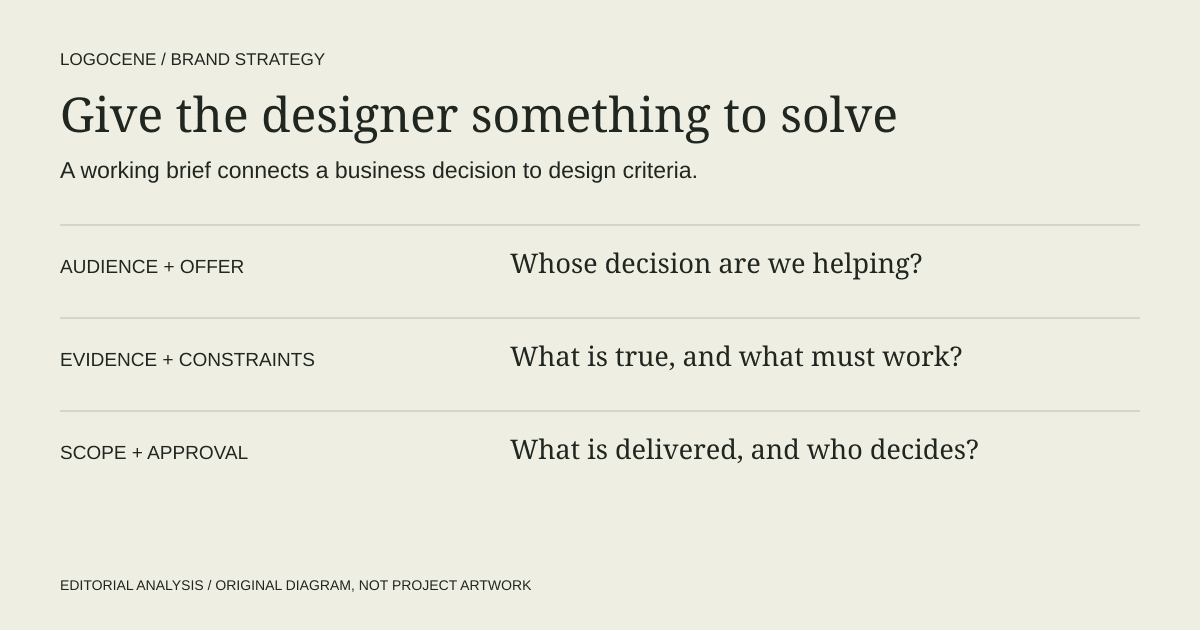
A useful brand brief describes a decision the identity must help someone make. Define the audience, the offer, the alternatives and the first applications, then give the designer evidence and constraints rather than a collection of preferred styles.
On this page
Describe the moment of choice
“Make us look professional” gives a designer little to investigate. A stronger starting point is a real situation: a homeowner comparing two renovation firms, a commuter choosing a repair shop or a parent deciding whether to book a first class.
Write what that person needs to understand and what might stop them choosing you. Separate evidence from assumption. A customer email is evidence of one person's concern. A founder's belief about what all customers want is a hypothesis to investigate.
The worksheet below is our editorial method. Structured brief templates can help you organise the material, but the useful work is making the content specific to the business.
A worked example: a neighbourhood repair service
Imagine a fictional clothing-repair business called Common Thread. It serves people who want everyday garments repaired without feeling that only expensive clothes deserve attention. The first applications are a shop window, a booking page, a price list and a small collection label.
The design problem is to make the service feel capable and approachable while helping people understand what can be repaired. “Crafted, premium, timeless” would leave too much unresolved. “Skilled work for clothes you actually wear” gives the identity and language a more concrete direction.
| Brief field | Specific input | What still needs research |
|---|---|---|
| Audience | Local people repairing everyday garments | Which jobs are most common and why people postpone them |
| Offer | Repairs with a clear estimate and collection process | Which service details customers find confusing |
| Alternative | Replace the garment, delay repair or use another shop | Why people choose each alternative |
| Evidence | Before-and-after repairs, skills and transparent process | Permission to publish examples and actual turnaround data |
| Character | Capable, plain-spoken and welcoming | Whether the proposed tone feels right to customers |
| Applications | Window, booking page, price list, collection label | Supplier dimensions and production constraints |
The example is a starting hypothesis, not a completed customer study. A few conversations with recent customers and people who declined the service could change it substantially.
Gather evidence before adjectives
Collect actual questions, complaints, purchase reasons and examples of how people describe the business. Remove unnecessary personal details before sharing the material. Ask the designer which uncertainties most affect the direction and decide what can be researched within the budget.
Identify the real alternatives. A restaurant competes with cooking at home as well as other venues. A subscription tool competes with a spreadsheet or doing nothing. Looking only at other logos can conceal the decision the identity is supposed to support.
For references, annotate the useful property. “This menu has a clear price hierarchy” is more actionable than “we like this brand.” Include references from outside the category when they clarify a layout, material or tone without encouraging imitation.
Specify production and access requirements
List the smallest and largest uses, materials, languages and channels. A wordmark that works in one script may need a different approach in another. A fine line that looks elegant on a screen may be unsuitable for the intended fabric or label process.
Ask for approved colour combinations for information as well as the logo. WCAG contrast guidance gives requirements for ordinary text that are separate from the logotype exception. Make accessible applications part of the brief before the palette is finalised.
Record who will edit the materials. A system maintained by one designer can use different tools from a system handed to several non-designers. Specify which templates, masters, font permissions and instructions the final handoff must include.
Decide how approval will work
Name one person who consolidates feedback. Agree the review criteria before seeing the concepts: audience fit, distinctiveness, legibility, practical reproduction and scope. Ask reviewers to explain a problem against those criteria rather than vote for a favourite colour.
Also assign responsibility for checking names and marks. For the US, the USPTO's search guidance covers word and design searches; other markets have their own registers and rules. A designer's delivery or a tool's commercial licence does not establish clearance.
Finish with an acceptance list. You should be able to identify what is delivered, what remains hosted, which revisions are included and which production work happens next. A good brief makes the project reviewable before it makes it beautiful.
Describe your business
Explore concepts from your brief, with colours, fonts and a web guide to help you use the logo you choose.
First watermarked preview free. Sign-in required; no card. Download credits: $9.99 for 10, about $1 per generation.
Questions
How long should a brand brief be?
Start with one or two pages plus clearly labelled supporting material. Length is less useful than completeness: a designer should understand the audience, decision, scope, evidence, deadline and approval process.
Should I include logos I like?
Yes, with reasons. Say which property matters, such as compact lettering or a useful small-size version. Include an example that would be wrong for the business and explain why.
Can I use the same brief with an AI tool?
Use a shorter version containing the business, audience, difference, character and intended uses. Keep the full brief for reviewing the result and preparing production files.